

Last Search Result
The Physics of Presence: How 180° and 360° VR Streaming Tricks the Brain Into Feeling There
18 January 2026
The Science of Presence in Virtual Reality
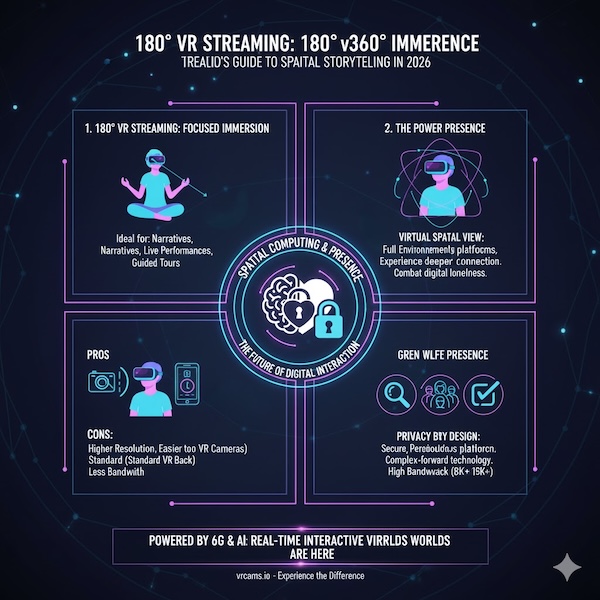
Presence in VR, whether it’s 180° or 360° VR streaming, depends on how well the system guides your senses and responses. When visuals, audio, and movement line up with what we expect, the experience feels real, almost uncannily so.
Defining Presence and Immersion
Presence in VR is that gut-level feeling of “being there” inside a digital world. It’s not just about the tech specs, immersion is more about the hardware: wide views, stereo sound, and low delay.
But presence? That’s personal. Some people slip right in, others don’t, even with the same headset. It’s a weirdly subjective thing, shaped by how the system responds to you.
Immersion can help, but it doesn’t always do the trick on its own. If controls are clunky or the feedback is off, the spell breaks fast.
From a phenomenology angle, presence is about how the world “shows up” for you. The virtual scene feels like it’s built around your body and your actions.
Mechanisms Behind the Sense of Being There in 360° VR Streaming
VR systems, especially in 180° and 360° VR streaming, create presence by matching how we naturally sense the world. Slightly different images for each eye create depth, and motion tracking ties your head and body movement to what you see.
If there’s lag, your brain notices. That’s when things start feeling off.
- Sensorimotor coupling: Your actions make the world react, just like real life.
- Multisensory cues: Sound and visuals line up in time and space.
- Scene stability: Objects stay put when you move your head.
When these cues line up, your brain predicts what should happen, and presence grows. If they don’t, you might feel dizzy or disconnected.
Neural Correlates and Conscious Experience
Neuroscience suggests presence relies on brain systems for perception, action, and attention. Vision, balance, and body awareness all work together here.
Presence shapes what you focus on and how real things seem. The brain treats the virtual world as the “now,” not just a picture on a screen.
Research shows presence can change your mental state, boosting focus or sparking emotion. When it’s strong, you’re glued to the virtual world.
But don’t worry, your brain isn’t fooled into thinking it’s all real. It’s just really good at playing along when the cues are right.
How 180° and 360° VR Streaming Alters Perception
180° and 360° VR streaming messes with your senses in the best way. Wide fields of view, tight motion syncing, and spatial audio can make your brain buy into the illusion of being somewhere else.
360° VR Streaming and Field of View
360-degree video wraps around you. When you turn your head, the world moves with you, which is key for presence in VR.
Wide field of view matters a ton. Narrow views remind you you’re just watching a screen, but when the visuals stretch out, it gets way more convincing.
180° video covers just the front, so you don’t see behind you. It’s still immersive, but it’s simpler to stream and can help with motion comfort.
| Format | Coverage | Key Effect |
|---|---|---|
| 180° | Front half | Focused immersion |
| 360° | Full sphere | Strong spatial awareness |
Sensory Integration in 360° VR Streaming
Your brain mixes up sight, motion, and balance to figure out where you are. For 360° VR streaming to work, those signals need to line up.
If visuals lag behind your head movement, you’ll notice, and probably feel a bit off. High frame rates and a steady horizon help a lot.
Depth cues are huge. Size, motion parallax, and how things overlap tell you how far away stuff is. When these match what you expect, the virtual world feels solid.
Simple things like good lighting, smooth camera moves, and natural motion help a ton. It’s not always about flashy effects.
Spatialized Sound in 360° VR Streaming
Spatial audio puts sounds in 3D space. Footsteps behind you, voices in front, it all shifts as you move your head, which totally grounds you in the scene.
Sound often leads your attention, even before you turn to look. In 360° VR streaming, this can make the world feel alive and responsive.
Environmental audio, like echoes or wind, adds realism. But it only works if it matches the visuals.
When sight and sound agree, your brain just rolls with it. You act like the space is real, even if you know it’s not.
VR Hardware and Display Tech for 360° VR Streaming
The hardware you use for 360° VR streaming shapes how real things feel. Display sharpness, timing, and sensor accuracy all matter for keeping the illusion alive.
The Rise of Head-Mounted Displays in 360° VR Streaming
Early headsets were clunky and made people queasy. Things have improved, modern gear is lighter, clearer, and way more comfortable.
Devices like Oculus Rift, HTC Vive, and PlayStation VR set the early bar. Mobile options like Samsung Gear or Google Cardboard made VR cheaper, but you lose some tracking and detail.
Now, comfort is a big deal. Better straps, less blur, and balanced weight mean you can stay in VR longer without wanting to rip the headset off.
Resolution and Lag in 360° VR Streaming
Resolution and timing control how stable the world feels. Each eye gets a slightly different image for depth, but if the pixels are too chunky, it ruins the effect.
Lag is even worse. If the image updates late, your brain knows something’s wrong. That’s when presence falls apart.
| Factor | Why It Matters |
|---|---|
| Resolution | Sharper detail helps with focus and depth |
| Refresh rate | Higher rates mean less flicker |
| Feedback delay | Short delays keep motion natural |
Most modern VR headsets aim for super low delay, especially for 180° and 360° VR streaming. It keeps movement feeling real.
Tracking and Motion Sensors for Immersive Streaming
Tracking systems tell your headset where you are and how you’re moving. If head tracking isn’t spot-on, the illusion falls apart.
High-end setups use cameras or sensors in the room, like HTC Vive or PlayStation VR. Some now put the cameras right on the headset, less setup, more freedom.
Eye-tracking is starting to show up in new gear. It lets the system know where you’re looking, so it can focus detail where it counts.
Fast, accurate sensors make everything feel smooth. That’s what keeps your brain buying into the virtual world.
Human Factors and Interactive VR Design for 360° VR Streaming
Designing interactive VR, especially for 360° VR streaming, means thinking about how people move, see, and feel. When motion feels natural and controls are quick, presence goes way up.
Degrees of Freedom in Immersive Streaming
Degrees of freedom (DoF) define how you move in VR. 3DoF tracks just head rotation; 6DoF tracks your position, too. For realistic interaction in 360° VR streaming, 6DoF is a must.
Tracking hands, head, and sometimes even your waist makes the virtual body feel like yours. If there’s lag or drift, you’ll notice right away.
Actions should match real-life movement. Grabbing something? Use a hand motion, not just a button. It’s more intuitive and satisfying.
Input Devices: Making 360° VR Streaming Interactive
Input devices, controllers, gloves, body suits, turn what you want to do into action. Each has trade-offs in comfort, precision, and cost.
| Device | Strengths | Limits |
|---|---|---|
| Controllers | Fast, reliable | Not always natural |
| Dataglove | Tracks hand poses | Setup can be tricky |
| Body suits | Full-body tracking | Can get hot, takes time |
| Trackers | Flexible placement | Needs charging |
Old-school inputs like joysticks or touch screens still help with menus. Haptics, vibration or force feedback, make actions feel more real, especially in 360° VR streaming.
Designing for Comfort and Accessibility in 360° VR Streaming
Comfort is everything. High frame rates and smooth motion help cut down on nausea. Snap turns and teleport movement are lifesavers for some folks.
Accessibility means more people can join in. Seated or standing modes, adjustable controls, and clear visuals all help.
Shorter sessions, lighter gear, and balanced headsets keep fatigue down. If you’re distracted by discomfort, you’re not really “there.”
Applications and Impact of Presence in 360° VR Streaming
Strong presence in 180° and 360° VR streaming changes how people learn, practice, and connect. When the illusion holds, users behave as if what’s happening matters, which leads to better results in training, therapy, and social VR.
VR Training and Education
Presence is what makes 360° VR Streaming and immersive training so effective, especially when mistakes have real consequences. In a virtual reality simulation, the headset almost fades away, letting trainees zero in on the task.
This kind of focus helps memory and speeds up skill transfer. It's not just theory, people actually learn faster.
Immersive training really shines in hands-on fields:
- Operating equipment and running safety drills
- Practicing medical procedures in a virtual reality lab
- Handling emergencies under pressure
In VR education, presence lets students spot cause and effect more clearly. When the movement and scale feel right, judging distance and timing gets easier.
Many schools use virtual reality in education for labs, history, and spatial learning, no need for a physical classroom.
Virtual Reality Therapy and Rehabilitation
Presence isn't just for fun, it's a big deal in VR therapy too. In virtual reality exposure therapy, patients face their fears, but in a safe, controlled space.
The brain responds to what it sees, not the room you're sitting in. That's the magic of being "there."
Clinics are using virtual environments for cognitive rehab now:
- Relearning daily habits after injuries
- Training attention and memory skills
- Working on balance and motor control
When the sense of presence is high, patients stick with the program longer. Therapists tweak the realism to keep things believable but not overwhelming.
These virtual reality tools make it easy to repeat exercises and get instant feedback.
Social Interaction and Virtual Avatars in 360° VR Streaming
Designing social VR is all about avatars that move and react in real time. When head, hand, and eye movements match what users do, presence goes up, so does trust.
Social VR spaces use these features for:
- Remote meetings with spatial audio (it really feels like you're in the room)
- Group learning and hands-on labs
- Live events and creative sessions
When people feel like they're sharing the same space, communication just flows better. Consistent rules for timing and interaction keep everyone focused.
Technical and Psychological Challenges in 360° VR Streaming
Getting presence right in 180° and 360° VR requires tight control over visuals, timing, and human quirks. Even tiny tech hiccups can ruin the illusion.
Resolution, Fatigue, and Streaming Limits
How sharp does it look? Resolution is everything. In 360° VR, pixels are spread across a huge field, so only a slice is crisp at any time.
Turn your head, and the blur is obvious. That can tire out your eyes fast.
This strain is called visual fatigue. The brain tries to fill in missing details, which gets exhausting.
- Low pixel density in some headsets
- Compression artifacts from streaming
- Mismatch between eye focus and depth cues
Research shows these factors make VR less comfortable and cut down the time people want to spend inside. Better display tech is a big focus for fixing this.
Lag, Latency, and Feedback in 360° VR Streaming
Latency is that annoying delay between moving your head and seeing the world update. Even a little lag feels wrong.
It's not just the visuals, audio, controllers, and motion cues have to sync up too. Otherwise, the brain notices, and the magic breaks.
- Network lag in live streaming
- Rendering delays for high-res scenes
- Sensor lag in tracking
Studies show more lag means less presence and more cybersickness. Not surprising, right?
Individual Differences in Presence
Not everyone experiences presence the same way. Some people get lost in VR instantly, while others spot every flaw.
- Experience with games or VR
- Sensitivity to motion or visual conflict
- Personality traits like focus or openness
Some folks feel strong immersion even with glitches. Others just get queasy.
Designers need to give users options to adjust comfort and realism for themselves.
The Future of 360° VR Streaming and Mixed Reality
We're seeing hardware and software evolve fast, shaping how real presence can feel. Better use of human vision, tighter links between real and digital, and lessons from the old days are all coming together.
Foveated Rendering: A Game-Changer for 360° VR Streaming
Foveated rendering puts sharp detail where your eye is looking and blurs the rest. It's clever and matches how our eyes actually work.
Modern headsets use this with eye tracking, cutting processing needs while keeping the image sharp. For 180° and 360° VR streaming, this means less bandwidth and smoother motion, which, honestly, is a relief for anyone prone to motion sickness.
- Higher frame rates on the same hardware
- Lower power use for mobile VR
- Sharper focus right where you need it
As GPUs and eye tracking get better, foveated rendering is becoming essential for immersion, not just a nice extra.
Mixed and Artificial Reality in the Streaming World
Mixed reality brings virtual objects into your real world, live. Devices like Microsoft HoloLens show how you can keep your bearings while digital stuff feels anchored and real.
Artificial reality tries to go even further, replacing or reshaping what you sense. It's a wild idea, think of the Ultimate Display, where everything responds just like the real world.
Tech like Kinect v2 improved body tracking, helping mixed reality systems map movement and space. This makes training and design feel more natural, since presence depends on scale, timing, and feedback being spot on.
Historical Milestones and Visionaries in 360° VR Streaming
Modern VR, especially in the realm of 360° VR streaming, stands on the shoulders of decades of innovation. Early inventions like the Link Trainer and those first flight simulators revealed how visuals could mess with our sense of reality.
Then came Sensorama, which tossed in sound and motion for a more complete experience. That was a game changer, honestly.
Ivan Sutherland dreamed up the Ultimate Display and got hands-on with some of the earliest head-mounted displays. Later, Jaron Lanier and his team at VPL Research nudged virtual reality, plus the whole 360-degree video idea, into pop culture and our everyday language. Virtual reality history is full of these moments.
Movies like The Lawnmower Man and The Matrix made people curious, even if the actual tech couldn't quite catch up at the time. If you want a deeper dive, check out this VR timeline.
Galleries
- Feeling Sexy
- Shay Laren 3
- Hottest Lifeguard
- Jesse Jane Black Lingerie
- Kennedy
- Biker babes
- Jenya perfect body
- Carmella nice pussy
- busty blonde Barbie
- Your Femdom Is Back
- Micky Bells Washes Her Large Breasts
- Nina sexy lingerie
- Breakfast With Iga
- Top Tit Star
- Jenna yellow
- The warm up
- Sarah Genova
- Sizzling Brunette Carmella In A Bath
- Tera Green Couch
- Alyssa Marie